
Timely for Siggraph 2014 (because animations use meshes) and food-for-thought for CFD (Computational Fluid Dynamics) research, the paper by A. Gorobets, F.X. Trias, R. Borrell, G. Oyarzún and A. Oliva, "Direct Numerical Simulation of Turbulent Flows with Parallel Algorithms for Various Computing Architectures" considers structured and unstructured meshes for incompressible … [Read more...]
Hot At Siggraph 2014 – Multithreading for Visual Effects

The ACM Siggraph conference starts tomorrow, August 10th, in Vancouver, BC. Multithreading for visual effects coupled with massive parallelism has changed the visual effects industry forever. A new book capturing that trend titled, appropriately enough, "Multithreading for Visual Effects", is an excellent source of information about how visual effects are currently performed at … [Read more...]
OpenACC OLCF Hackathon – Applications Accepted Aug 15 – 29

Oakridge National Laboratory announces the OLCF’s first ever hackathon will take place October 27-31, 2014. Apply between 15 - 29. Contact Fernanda Foertter. So what is this all about? Teams of developers will attend a 5-day intensive hands-on workshop guided by OpenACC mentors. These experts come from labs, universities and vendors and will guide your team from start to … [Read more...]
Breadth-First Graph Search Uses 2D Domain Decomposition – 400 GTEPS on 4096 GPUs
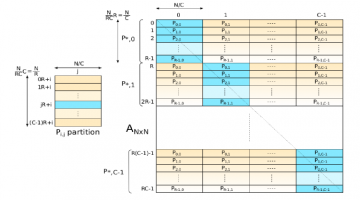
Parallel Breadth-First Search is a standard benchmark and the basis of many other graph algorithms. The challenge lies in partitioning the graph across multiple nodes in a cluster while avoiding load-imbalance and communications delays. The authors of the paper, "Parallel Breadth First Search on the Kepler Architecture" utilize an interesting 2D decomposition of the graph … [Read more...]
Deep-learning Webinar Demonstrates Handwriting Recognition and Efforts to Teach Drone to Fly Down a Wooded Path

Deep-learning is a computational expensive but rewarding method to solve many complex pattern recognition problems. The recent NVIDIA webinar by Dan Claudiu Cireșan, Senior Researcher at the Dalle Molle Institute for Artificial Intelligence (IDSIA) in Switzerland highlighted some of the capabilities of deep-learning for image recognition problems such as handwriting recognition … [Read more...]
SC14 – Fast Hybrid GPU Betweenness Centrality Code Achieves Nearly Ideal Scaling to 192 GPUs
Don't miss the SC14 presentation Wednesday Nov. 19 in room 388-89-90, for the presentation of the McLaughlin and Bader paper "Scalable and High Performance Betweenness Centrality on the GPU". The authors report nearly ideal scaling to 192 GPUs and billions of edges traversed per step (GTEP). The paper can be downloaded here and their software can be downloaded from … [Read more...]
Harvard Origami Robots Fold Themselves and Walk Away

Okay, this is cool (albeit slow if you watch the timeline in the video). Researchers at Harvard and the Massachusetts Institute of Technology demonstrated how a single thin sheet composed of interconnected triangular sections could transform itself into a boat or plane shape — without help. The findings were published in the Proceedings of the National Academy of … [Read more...]
IBM TrueNorth a “Bee Brain” on a SyNAPSE Chip That Uses 70 mW

IBM unveiled the first neurosynaptic computer chip on August 7th that implements one million programmable neurons, 256 million programmable synapses and 46 billion synaptic operations per second per watt. The IBM announcement, published in Science in collaboration with Cornell Tech, is a step towards bringing cognitive computers to society.At 5.4 billion transistors, this fully … [Read more...]
Intel Paper Detailing the Gen 7.5 GPU Architecture – Attention OpenCL Programmers !
Intel has labeled the Haswell graphic core as Gen 7.5 and the Ivy Bridge GPU as Gen.7. The latest Gen 7.5 Architecture paper, "The Compute Architecture of Intel® Processor Graphics Gen7.5" has now been released by Intel. This paper is written for those who wish to know the "architecture characteristics relevant to running compute applications on Intel® Processor … [Read more...]
SC14 WACCPD Workshop on Accelerator Programming Using Directives
Call For Papers for the SC14 Workshop on Accelerator Programming Using Directives (WACCPD), which brings together leading researchers and software designers at the forefront of the application of high-level directives to program accelerator-based architectures. Using directives improve productivity, and program portability with minimal changes to the applications while … [Read more...]