
Dharmendra S Modha's Cognitive Computing Blog appears to be an excellent source of information about the IBM SyNAPSE project. Following is a clickable map of papers about the SyNAPSE Ecosystem that is well worth exploring. Also note that Dr. Modha has a link or jobs and a form for summer intern applications! Vertically–Integrated SyNAPSE Ecosystem (A Clickable Map of Papers … [Read more...]
Commercial OpenCL! SPIR 2.0 Protects IP Yet Allows Powerful, Portable, Source Code Free Kernels

It used to be that portable OpenCL applications required shipping source code for the parallel kernels with the application. In this way, the kernel source code could be compiled for any device at any time in the future. Bad news from an IP protection point of view! The alternative was to pre-compile the kernels thus bloating applications and limiting the devices the OpenCL … [Read more...]
Acer K1-powered Chromebook $279 for Pre-Order – Dual-boot Linux?

The Acer Chromebook 13, priced at $279, is the first Chromebook to use an NVIDIA Tegra K1 processor. It offers customers fast graphics and a 13-hour battery in an ultra-mobile form factor. Available for presale now at Amazon.com and BestBuy.com. Spec from Amazon.com: Screen Size 13.3 inches Max Screen Resolution 1366 x 768 pixels Processor 2.1 GHz … [Read more...]
GPU Accelerated Genetic Algorithm Can Plan Drone Missions
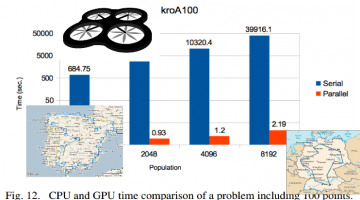
Both the military and commercial organizations like Amazon will be interested in the GPU accelerated genetic algorithm (GA) proposed in the paper "UAV Path Planning with Parallel Genetic Algorithms on CUDA architecture" to create flight plans for drones. The authors noted "The experiments in this study show that the results reach up to 24 times speedup comparing to the CPU … [Read more...]
Machine-Learning At Siggraph Changes the Weather and Other Aspects of an Image

More machine-learning at Siggraph. A paper describing a machine-learning method being developed a Brown University enables users to instantly change the weather, time of day, season, or other features in outdoor photos with simple text commands. Changing the weather in a photo involves much more than simply turning a blue sky gray. There are subtle changes in color and … [Read more...]
Depth-Categorizing GPU-Accelerated Deep Neural Networks Perform Fast Semantic Segmentation of RGB-D Scenes
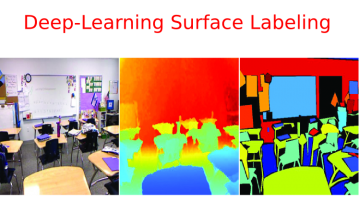
Interesting for computer vision and animation, the paper by Nico Höft, Hannes Schulz, and Sven Behnke, "Fast Semantic Segmentation of RGB-D Scenes with GPU-Accelerated Deep Neural Networks" categorizes the surface to which each pixel in an image belongs. Semantic scene segmentation is a major challenge on the way to functional computer vision systems that can separately label … [Read more...]
WRF Comparison – Neither Phi or NVIDIA M2070 Living Up to Name
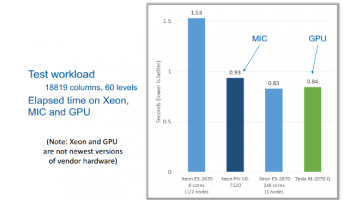
WRF (Weather Research and Forecasting) is an important benchmark for weather modeling, computational scientists, and procurements. WRF is a mesoscale numerical weather prediction system designed to serve both atmospheric research and operational forecasting needs. It allows researchers to generate atmospheric simulations based on real data (observations, analyses) or … [Read more...]
Paper Compares AMD, NVIDIA, Intel Xeon Phi CFD Turbulent Flow Mesh Performance Using OpenMP and OpenCL

Timely for Siggraph 2014 (because animations use meshes) and food-for-thought for CFD (Computational Fluid Dynamics) research, the paper by A. Gorobets, F.X. Trias, R. Borrell, G. Oyarzún and A. Oliva, "Direct Numerical Simulation of Turbulent Flows with Parallel Algorithms for Various Computing Architectures" considers structured and unstructured meshes for incompressible … [Read more...]
Deep-learning Webinar Demonstrates Handwriting Recognition and Efforts to Teach Drone to Fly Down a Wooded Path

Deep-learning is a computational expensive but rewarding method to solve many complex pattern recognition problems. The recent NVIDIA webinar by Dan Claudiu Cireșan, Senior Researcher at the Dalle Molle Institute for Artificial Intelligence (IDSIA) in Switzerland highlighted some of the capabilities of deep-learning for image recognition problems such as handwriting recognition … [Read more...]
SC14 – Fast Hybrid GPU Betweenness Centrality Code Achieves Nearly Ideal Scaling to 192 GPUs
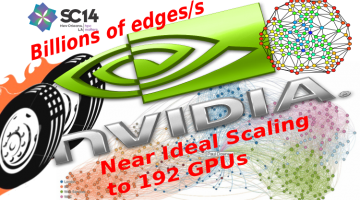
Don't miss the SC14 presentation Wednesday Nov. 19 in room 388-89-90, for the presentation of the McLaughlin and Bader paper "Scalable and High Performance Betweenness Centrality on the GPU". The authors report nearly ideal scaling to 192 GPUs and billions of edges traversed per step (GTEP). The paper can be downloaded here and their software can be downloaded from … [Read more...]