
The Tegra K1-powered NVIDIA Shield Tablet is here - available July 29 in the US! Pre-order here! For more information on the shield tablet, or go to shield.nvidia.com. http://youtu.be/VohrddwVQqg Those who are adventurous, Caonical has a dual-boot mode that will allow Ubuntu to run on tablets, and potentially other devices bringing full Linux and CUDA … [Read more...]
TechEnablement Adds Funding Opportunity Posts via Dr. William Reynolds

TechEnablement is pleased to announce that Dr. William Reynolds PhD - an expert in applied scientific computing, funding proposals, and government research, - will be identifying pending funding opportunities for our readership. These posts will round out the TechEnablement content pool to (1) educate readers about the current technology, (2) plan both applications and … [Read more...]
ARM64 and x86 With OpenMP 4.0 For HPC and Enterprise in GNU and Possibly Clang

The OpenMP 4.0 specification is moving quickly to implementation through the GNU toolchain and Clang. TechEnablement reported that GNU 4.9.1 now supports OpenMP in C/C++ and Fortran plus we now have confirmation that OpenMP will run on ARM64 as well, or as Jakub Jelinek wrote, "All architectures where libgomp is supported (which is essentially all which have pthreads)." The … [Read more...]
NVIDIA Shield 2 will be a tablet (with stylus) as well as a gaming device!
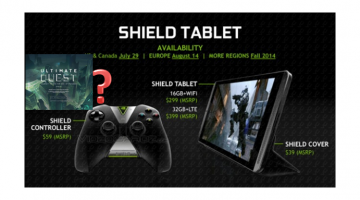
It's looks like it is true (and it can now be ordered), the K1-powered Shield 2 Gaming console will also be an 8" tablet! What a cool idea! This will be a CUDA/Gamers/Tablet/(cellphone?) honey of a device. (July 22: It's available now!). NVIDIA has created a tweet-based game "Ultimate Quest" in what is believed to be a promotion for the Shield 2. Click on the image below … [Read more...]
GCC 4.9.1 Adds OpenMP 4.0 Fortran Support for Multicore
Jakub Jelinek <jakub at redhat dot com> posted on July 16th that the GCC 4.9.1 release now supports OpenMP 4.0 in Fortran (as well as C/C++). This is great news for multi-core programmers. GCC looks to be on-track to become the opensource platform that both Intel Xeon Phi and GPU programmers can use to to test pragma based programming. As reported on techEnablement.com, … [Read more...]
Extreme Test – NVIDIA Shield Portals Two 9-year Old Boys Through 20-hour Road Trip

The Tegra 4 NVIDIA Shield is a powerful, portable handheld gaming console that can play demanding first-person video games like Valve's Portal with long battery life. A recent extreme, real-world test with two active nine-year old boys on a cumulative twenty-hour round-trip-road trip demonstrated in-car happiness by all occupants. The combination of an Xbox like controller … [Read more...]
Part 1: Load-Balanced, Strong-Scaling Task-Based Parallelism on GPUs

Achieve a 7.4x speedup with 8 GPUs over the performance of a single GPU through the use of task-based parallelism and concurrent kernels! Traditional GPU programming typically views the GPU as a monolithic device that runs a single parallel kernel across the entire device. This approach is fantastic when one kernel can provide enough work to keep the GPU busy. The conundrum is … [Read more...]
Call for Papers: Women in HPC at Supercomputing 2014 due July 31

Awareness of the need for diversity in computing is growing. The Women in High Performance Computing (WHPC) is welcoming submissions from female early career researchers and post doctoral students to present a talk or poster on their work in any field of HPC at the workshop. Submission are due by July 31, 2014. Click here for more details. The WHPC SC14 call is the … [Read more...]
GCC likely to support both OpenACC and Intel Xeon Phi Offload Pragmas in 2015
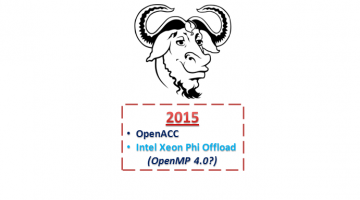
It looks like GCC will be supporting both OpenACC and Intel Xeon Phi offload pragmas in future releases. Perhaps the GNU compiler chain will become the melting pot where OpenACC and OpenMP 4.0 pragmas merge to become a single unified syntax. According to Nathan Sidwell, Director of Sourcery Services at Mentor Embedded, their OpenACC effort is working to “make the underlying … [Read more...]
South Africa Team Wins Their Second Student Supercomputing Competition At ISC14
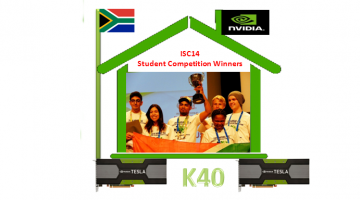
Congratulations to the South African students who won their second ISC14 Student Supercomputing Competition! In 2013 the South African students were considered the underdog due to their youth and lack of competitive experience. This year the team from the South African Centre for High Performance Computing won the overall 2014 competition. To win, students have to build a … [Read more...]