
OakRidge National Laboratory has announced three GPU Hackathons for 2015. The first will be hosted April 20-24 by the National Center for Supercomputing Applications on the UIUC Campus. The second will be hosted by the Swiss National Supercomputing Centre in Lugano, Switzerland from July 6-10. The final one will be hosted by the Oak Ridge Leadership Computing Facility on … [Read more...]
Rumor – Tegra X1 Powered Shield Tablet Announcement in March 2015

Rumors are circulating that the Tegra X1 powered update to the NVIDIA Shield Tablet will be announced at the GPU technology conference scheduled for March 17th or possibly earlier. Indications are the screen size will stay the same, but that appears to be the only leaked information. This is great news, along with the fact that Ubuntu 14.10 now runs on the Tegra K1 powered … [Read more...]
Guide to Get Ubuntu 14.10 Running Natively on Nvidia Shield Tablet

The XDA forum developer Bogdacutu reports they have Ubuntu 14.10 running on an NVIDIA Shield Tablet and have provided a guide so others can also get Ubuntu running on their Shield tablets. This is wonderful news and brings hope that Ubuntu will soon be running on the rumored Tegra X1 refresh of the Shield Tablet. What works: GPU acceleration (OpenGL … [Read more...]
Horst Simon Explains the HPC Slowdown (and Human Brain Scale Simulation)
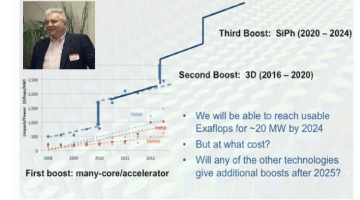
HPC luminary Horst Simon, the Berkeley Lab Deputy Director, gave a marvelous talk at an HPC meetup event in San Francisco on Feb 10 covering power efficiency and the movement towards exascale computing. Horst presented data and the conclusion that the June 2008 - June 2013 five-year span marks a turning point where the growth attributed to Moore’s law and parallelism are … [Read more...]
Power Profiling Shows Simple Changes To Save Megawatts of Power On Leadership Supercomputers

A challenge with profiling applications lies in how to interpret the profile results. In particular, most programmers do not give the power profile plots more than a cursory glance. Following is an example waterfall plot showing the power utilization for an NWChem run on Intel Xeon Phi coprocessors: My recent column in Scientific Computing, "Using Profile Information for … [Read more...]
Preparing For Knights Landing – Stay in HBM Memory

NERSC published an informative preparatory article for programming the forthcoming Cori supercomputer that notes each Intel Xeon Phi “Knight’s Landing” (KNL) devices will be running in a “self-hosted” mode, meaning that there will be no host/traditional processor. Everything - including the operating system - will run on KNL. This eliminates concerns about data movement as … [Read more...]
2015 HPC Advisory Council Presentations Available Online
The presentation slides from the 2015 HPC Advisory Council held at Stanford are now available for all to view on the Internet. InsideHPC is bringing videos of the presentations online as well. http://youtu.be/nhF9Wc9_RQY … [Read more...]
MAGMA LU Decompositions, Factorizations, and Eigensolvers for Intel Xeon Phi Coprocessors Released

MAGMA MIC 1.3.1 now provides implementations for MAGMA's one-sided (LU, QR, and Cholesky) and two-sided (Hessenberg, bi- and tridiagonal reductions) dense matrix factorizations, as well as linear and eigenproblem solver for Intel Xeon Phi Coprocessors. The MAGMA MIC 1.3.1 release adds Added orthogonal transformations … [Read more...]
Attend or Submit to the 3rd IWOCL May 12-13, 2015 at Stanford University

The 3rd IWOCL (International Workshop on OpenCL) takes place at Stanford University, California from Tuesday 12 to Wednesday 13 May 2015. Workshops are held on the Tuesday, followed by the one-day conference on Wednesday. The conference is accompanied by a poster session and table-top displays by sponsors. OpenCL Papers, Workshops and Posters The IWOCL 2015 call for … [Read more...]
Free IEEE OpenACC Webinar Using the PGI Compiler

Register here to view a recent Dec. 11, 2014 IEEE webinar on OpenACC by Michael Wolf, a compiler engineer at PGI, who presents the latest PGI support for C++ features and will look at the roadmap for more complete PGI OpenACC support in the future. Michael will also show some significant performance enhancements that should impact all OpenACC programmers. He closes with a short … [Read more...]