• Home
  • News
  • Tutorials
  • Analysis
  • About
  • Contact

TechEnablement

Education, Planning, Analysis, Code

  • CUDA
    • News
    • Tutorials
    • CUDA Study Guide
  • OpenACC
    • News
    • Tutorials
    • OpenACC Study Guide
  • Xeon Phi
    • News
    • Tutorials
    • Intel Xeon Phi Study Guide
  • OpenCL
    • News
    • Tutorials
    • OpenCL Study Guide
  • Web/Cloud
    • News
    • Tutorials
You are here: Home / Featured article / Facebook HHVM Saves Wikipedia 30% Page Load Time and 50% CPU load over Zend

Facebook HHVM Saves Wikipedia 30% Page Load Time and 50% CPU load over Zend

January 13, 2015 by Rob Farber Leave a Comment

The Wikipedia blog, “How we made editing Wikipedia twice as fast” by Ori Livneh discusses the tremendous impact of switching to the open-source Facebook Hip Hip Virtual Machine (HHVM) for PHP. The HHVM code essentially converts interpreted PHP code to x86 instructions that can run natively on the CPU. This translates to much higher performance by avoiding PHP’s usual  intepreted execution where the Zend Engine transforms the PHP source code into opcodes that are intepreted by the Zend Engine. The conversion to HHVM took approximately 6 months and included extensive verification of correct behavior. Ori noted that the Wikipedia team spent a significant amount of time fixing edge cases were the PHP code acted differently when running under HHVM.

For a top 10 site that services half a billion people each month, performance is critical to Wikipedia in terms of page response time and server load. These metrics translate to user retention and infrastructure expenses such as number of machines purchased and data center heating/cooling costs.

The following graphic shows a clear decrease in page load times:

Reduction in page load time as a result of the conversion to HHVM. (Image courtesy Wikipedia)

During that same time, Wikipedia also saw a significant reduction in server CPU utilization:
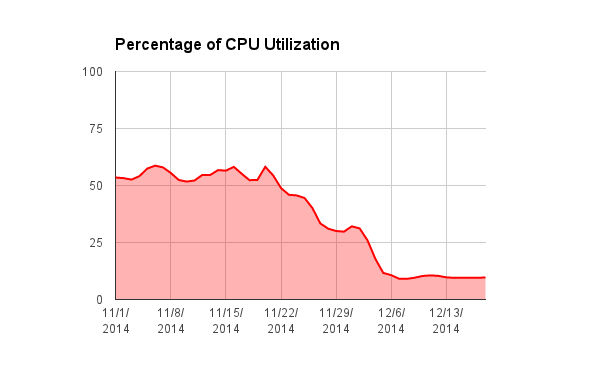
Reduction in CPU load as a result of conversion to HHVM. (Image courtesy Wikipedia)


The following video goes into greater depth on the Wikipedia conversion to HHVM

For high-traffic sites, HHVM looks to be an interesting project. See the Facebook HHVM github page for more information on the Hip Hop Virtual Machine.

Share this:

  • Twitter

Filed Under: Featured article, Featured news, News, News, Web/Cloud Tagged With: PHP

Leave a Reply Cancel reply

Your email address will not be published. Required fields are marked *

Tell us you were here

Recent Posts

Farewell to a Familiar HPC Friend

May 27, 2020 By Rob Farber Leave a Comment

TechEnablement Blog Sunset or Sunrise?

February 12, 2020 By admin Leave a Comment

The cornerstone is laid – NVIDIA acquires ARM

September 13, 2020 By Rob Farber Leave a Comment

Third-Party Use Cases Illustrate the Success of CPU-based Visualization

April 14, 2018 By admin Leave a Comment

More Tutorials

Learn how to program IBM’s ‘Deep-Learning’ SyNAPSE chip

February 5, 2016 By Rob Farber Leave a Comment

Free Intermediate-Level Deep-Learning Course by Google

January 27, 2016 By Rob Farber Leave a Comment

Intel tutorial shows how to view OpenCL assembly code

January 25, 2016 By Rob Farber Leave a Comment

More Posts from this Category

Top Posts & Pages

  • N-body Methods on Intel Xeon Phi Coprocessors
  • Performance Optimization Of Black-Scholes Pricing On Intel Xeon Phi
  • Turn Glasses or Sunglasses into Smart Glasses with Sony Device
  • News
  • PGI/NVIDIA To Develop LLVM-based Open-Source Fortran Compiler for NNSA and Possibly OpenPower

Archives

© 2026 · techenablement.com