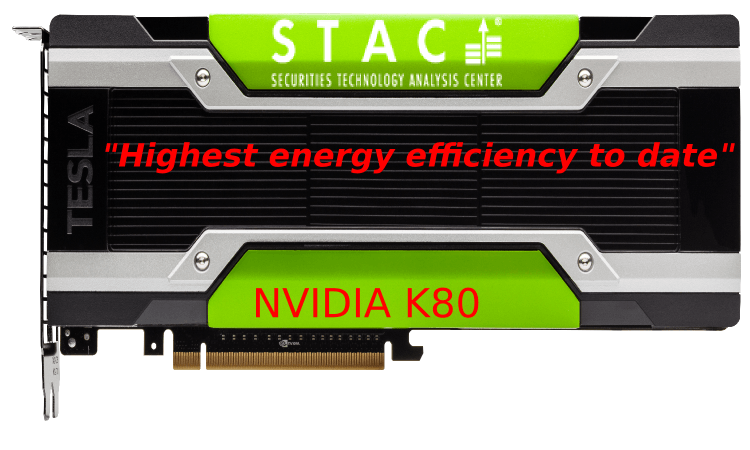
STAC, the financial industry benchmarking organization, released performance testing results on the new NVIDIA Tesla K80 Dual-GPU Accelerator. In the STAC-A2 benchmark, which helps financial institutions and banks better manage risk, the NVIDIA Tesla K80 GPU set new performance records. The test code only used two threads on the host processor plus the K80 CUDA code was optimized to take advantage of the increased K80 memory.
Specifically STAC noted (source) the NVIDIA K80 GPU had the:
- Highest energy efficiency to date (STAC-A2.β2.GREEKS.EFFICIENCY). This was 40% better efficiency than the next best system (INTC140507).
- Fastest warm time to date in the baseline end-to-end Greeks benchmark (STAC-A2.β2.GREEKS.TIME.WARM). This was 1.85x the speed of the next fastest system (INTC140815).
- Fastest cold time to date in the baseline benchmark (STAC-A2.β2.GREEKS.TIME.COLD). This was 1.65x the speed of the next fastest system (INTC140509).
STAC-A2 is a user-developed benchmark standard based on financial market risk analysis. Designed by quants and technologists from some of the world’s largest banks, STAC-A2 reports the performance, scaling, quality, and resource efficiency of any technology stack that is able to handle the workload (Monte Carlo estimation of Heston-based Greeks for a path-dependent, multi-asset option with early exercise).
Read more about the STAC-A2 benchmark in the paper, “End-User Driven Technology Benchmarks Based on Market-Risk Workloads” by Peter Lankford (STAC), Lars Ericson(Catskills Research Company), and Andrey Nikolaev (Intel Corporation).
The test system was configured as follows:
- NVIDIA CUDA 6.5
- NVIDIA cuRand and cuBLAS
- CUB library
- Eigen 3 library
- 1 x NVIDIA K80 GPU Accelerator
- Supermicro SYS-2027GR-TRFH server
- 2 x 10-core Intel Xeon E5-2690 v2 @ 3.0GHz (Ivy Bridge)
- CentOS Linux 6.6
- 128 GB Samsung DDR3 RAM
For more information, see:
- The NVIDIA Blog post, “STAC Attack“.
- The STAC test results are available to account holders here.
About STAC
STAC® provides technology research and testing tools based on community-source standards. This accelerates technology selection at user firms while reducing the sales cycle for vendors. The standards are developed by the STAC Benchmark Council™, a group of major financial firms and other “algorithmic enterprises” as well as leading technology vendors.
Leave a Reply