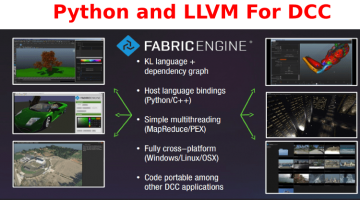
A company called FabricEngine (http://fabricengine.com) is leveraging the power of LLVM and Python to compile optimized code for Digital Content Creation (DCC) that can run on multicore and GPUs. Products like these demonstrate the acceptance of Python and LLVM into commercial/enterprise high-performance HPC applications just like PyFR and deep-learning. Integrated with … [Read more...]
Compare Augmented Reality Displays from NVIDIA, Oculus Rift, Meta, and Others (updated)

Augmented reality is poised to be the new computing display revolution - essentially the gold rush of the early 21st century. The key is the display. Following is information on various displays like Pinlight (110-degrees NVIDIA/UNC), Oculus Rift (110-degrees), Meta Space Glasses, Google Glass (& Navdy), plus the Brother AIRScouter and Lumus. One of the big issues is a … [Read more...]
XSEDE Seeking Partner Institutions to Offer Online Course in Applications of Parallel Computing

XSEDE and the University of California, Berkeley are offering an online course on parallel computing for graduate students and advanced undergraduates and are seeking other university partners that are interested in offering the course for credit to their students. The course includes online video lectures, quizzes, and homework assignments with access to free accounts on the … [Read more...]
Deep-Learning Challenge – Google Chose Nevada Self-Driving Car Test Route and Conditions

With the advent of deep-learning, open and impartial validation of complex learning and adaptive systems is becoming ever more important. For example drones and self-driving cars operate in true life-and-death situations where biases in a validation test can result in collisions with people, property, and other vehicles. In my Scientific Computing article, "Validation: … [Read more...]
Try Intel’s OpenCL 2.0 SDK With SPIR

The Intel OpenCL 2.0 SDK is available for download. Look to . Commercial OpenCL developers note that this release includes SPIR (Standard Portable Intermediate Representation) to protect your codes while preserving portability. This version supports Android and the re-architected Intel Gen8 "Broadwell" GPUs with powerful features like coherent shared virtual memory for … [Read more...]
Intel Broadwell Compute Gen8 GPU Architecture

Attention OpenCL programmers! Intel has released a detailed description of the Gen8 Broadwell GPU compute architecture, "The Compute Architecture of Intel® Processor Graphics Gen8". Broadwell is a 14nm die shrink of Intel’s microarchitecture incorporating significant reworking of the Intel HD 5000-series (Iris) Gen 7.5 GPU found in Haswell including: (1) throughput for 32-bit … [Read more...]
GCC 5.0 Provides Full Cilk Plus Support

GNU has announced that GCC 5.0 will provide full support for Cilk Plus. Cilk Plus is an extension to the C and C++ languages to support data and task parallelism on multi-core, vector and Intel Xeon Phi coprocessors.It is reputed to be quite efficient and looks to be easy to use. The Intel icc compiler has supported Cilk Plus for years. GNU support now makes Cilk Plus available … [Read more...]
Programming Deep-learning Neural Networks to Solve Tasks
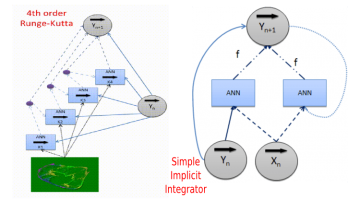
Deep-learning neural networks can be programmed, or structured by a human to perform one or more complex tasks. The key requirements are the ability to (1) design the network topology and (2) lock weights in the ANN (Artificial Neural Network) during training. A powerful example of structured deep-learning comes from the 1993 Farber, et.al. paper, "Identi fication of … [Read more...]
Feynman Lectures on Physics Now Free to Study Online

Caltech and The Feynman Lectures Website are pleased to present this online edition of The Feynman Lectures on Physics. Now, anyone with internet access and a web browser can enjoy reading a high quality up-to-date copy of Feynman's legendary lectures. This edition has been designed for ease of reading on devices of any size or shape; text, figures and equations can all be … [Read more...]
GPUs Power Over 90% of ImageNet Deep-Learning Visual Recognition Challenge Entries
Over 90 percent of the participating teams and three of the four winners in the prestigious 2014 ImageNet Large Scale Visual Recognition Challenge used GPUs to enable their deep learning work. Deep learning is a fast-growing segment of machine learning that involves the creation of sophisticated, multi-level or “deep” neural networks. These networks enable powerful … [Read more...]