
Peter Vincent's original PyFR post on TechEnablement has been extremely popular. Readers should be happy to hear that the PyFR team has published a new paper, "Heterogeneous Computing on Mixed Unstructured Grids with PyFR", showing this Python framework can perform high-order accurate unsteady simulations of flow on mixed unstructured grids using heterogeneous multi-node … [Read more...]
RAD (Rapid App Development) Languages for HPC and Cloud – Python, R, Julia
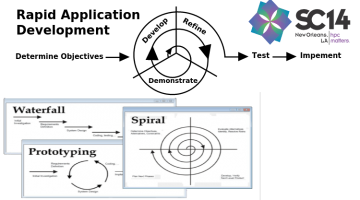
It feels like an oxymoron to speak of interpreted languages for HPC much like ordering "jumbo shrimp". The ease of programming coupled with an ability to augment RAD (Rapid Application Development) languages like Python, R, and Julia with high-performance back-end methods is now being recognized by the HPC and cloud computing communities. In short, the RAD language provide … [Read more...]
Funding for HPC in the Natural Sciences at Mainz University

Many branches of the natural sciences are currently in the process of transition to the use of data-driven concepts. In recognition of this, the Carl Zeiss Foundation will provide EUR 750,000 over four years to fund the Competence Center for HPC in the Natural Sciences at the Institute of Computer Science of Johannes Gutenberg University Mainz (JGU). Jointly headed by Professor … [Read more...]
Lustre Delivers 10x the Bandwidth of NFS on Intel Xeon Phi
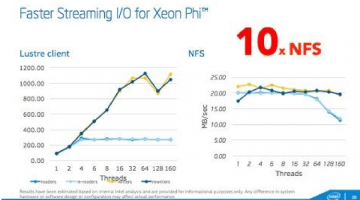
Lustre on Intel Xeon Phi delivered 10x the bandwidth of NFS as reported in the 2014 Lustre User Group (LUG) presentation "Running Native Lustre* Client inside Intel® Xeon Phi™ coprocessor" by Dmitry Eremin, Zhiqi Tao and Gabriele Paciucci of Intel Corporation. Network file systems are essential to the current generation of Knights Corner Intel Xeon Phi coprocessors because the … [Read more...]
OpenACC Compilers Deliver 85% The Performance Of Hand-Optimized Code

Directive-based compilers offer both portability and the ability to optimized code for specific platforms such as GPUs and CPUs. A recent LCPC14 paper, "Directive-Based Compilers for GPUs", by Swapnil Ghike, Ruben Gran, Maria J. Garzaran, David Padua at the University of Illinois at Urbana-Champaign found OpenACC code generated by the PGI and Cray OpenACC compilers achieved … [Read more...]
Deep-Learning Behind Microsoft Cross-Language Real-Time Skype Translator
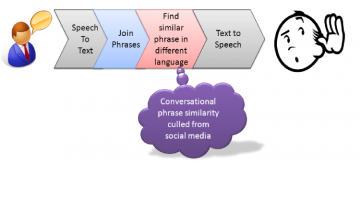
Deep-learning lies at the heart of the Microsoft Skype translator, a near real-time speech-to-speech machine translation tool that enables voice conversations between individuals speaking different languages. The claim is that a beta version of Skype Translator will be released sometime in 2014. According to Microsoft, machine-learning of large datasets culled from social … [Read more...]
Intel SPMD Compiler (ISPC) for Xeon and Xeon Phi

When #pragma SIMD is not enough, companies and projects such as Intel, Embree, Dreamworks, Pixar, Autodesk, and SURFsara are looking to the freely available Intel SPMD Program Compiler (ispc) to achieve high vector performance on Xeon and Intel Xeon Phi devices. ISPC is LLVM-based and designed to exploit Intel SIMD architectures … [Read more...]
CUDA 340.29 Driver Significantly Boosts GPU Performance (100s GF/s For Machine-Learning)
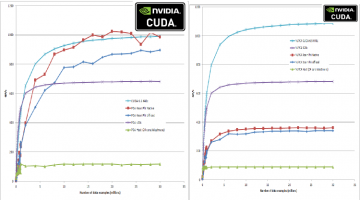
Reports are now coming in about performance boosts that are the result of the CUDA 6.5 production release. The Blender project reports faster rendering time with CUDA-6.5. As can be seen in the graphs below that report performance on the farbopt deep-learning teaching code, CUDA-6.5 with the NVIDIA 340.29 driver have increased performance on linear problems (PCA analysis from … [Read more...]
AAA-Battery Powered Water Splitter Poses Computational Opportunity
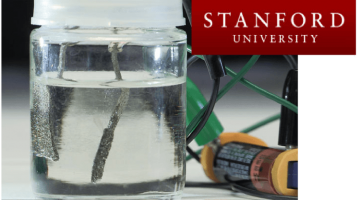
Stanford Scientists have developed a water splitter that runs on an ordinary AAA battery and uses commonly available nickel and iron - no exotic materials required! The "save the planet" potential is clearly there as such a low-voltage, low-amperage conversion opens the potential for solar conversion of water to hydrogen. The discovery was made by Stanford graduate student Ming … [Read more...]
PyFR: A GPU-Accelerated Next-Generation Computational Fluid Dynamics Python Framework
PyFR is an open-source 5,000 line Python based framework for solving fluid-flow problems that can exploit many-core computing hardware such as GPUs! Computational simulation of fluid flow, often referred to as Computational Fluid Dynamics (CFD), plays an critical role in the aerodynamic design of numerous complex systems, including aircraft, F1 racing cars, and wind turbines. … [Read more...]