
TechEnablement is growing! We are happy to announce that we moved to SSD storage to help speed our site given our rapidly growing readership around the world. Our next step will be to enable a global content delivery network. Thank you for helping us grow so quickly! … [Read more...]
GCC 5.0 Provides Full Cilk Plus Support

GNU has announced that GCC 5.0 will provide full support for Cilk Plus. Cilk Plus is an extension to the C and C++ languages to support data and task parallelism on multi-core, vector and Intel Xeon Phi coprocessors.It is reputed to be quite efficient and looks to be easy to use. The Intel icc compiler has supported Cilk Plus for years. GNU support now makes Cilk Plus available … [Read more...]
Houston Workshop: Directives and Tools for Accelerators: A Seismic Programming Shift

With space for 70-80 participants, those who wish to attend the FREE University of Houston workshop, "Directives and Tools for Accelerators: A Seismic Programming Shift" must register by October 10th, 2014. The workshop is a fill-day event on October 20th, 2014, with a preceding welcome reception on October 19th, 2014. THis workshop is organized by the HPC Tools group in the … [Read more...]
Programming Deep-learning Neural Networks to Solve Tasks
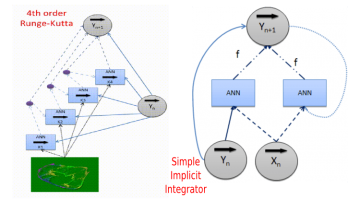
Deep-learning neural networks can be programmed, or structured by a human to perform one or more complex tasks. The key requirements are the ability to (1) design the network topology and (2) lock weights in the ANN (Artificial Neural Network) during training. A powerful example of structured deep-learning comes from the 1993 Farber, et.al. paper, "Identi fication of … [Read more...]
Feynman Lectures on Physics Now Free to Study Online
Caltech and The Feynman Lectures Website are pleased to present this online edition of The Feynman Lectures on Physics. Now, anyone with internet access and a web browser can enjoy reading a high quality up-to-date copy of Feynman's legendary lectures. This edition has been designed for ease of reading on devices of any size or shape; text, figures and equations can all be … [Read more...]
GPUs Power Over 90% of ImageNet Deep-Learning Visual Recognition Challenge Entries
Over 90 percent of the participating teams and three of the four winners in the prestigious 2014 ImageNet Large Scale Visual Recognition Challenge used GPUs to enable their deep learning work. Deep learning is a fast-growing segment of machine learning that involves the creation of sophisticated, multi-level or “deep” neural networks. These networks enable powerful … [Read more...]
New PyFR Paper “Heterogeneous Computing on Mixed Unstructured Grids with PyFR”

Peter Vincent's original PyFR post on TechEnablement has been extremely popular. Readers should be happy to hear that the PyFR team has published a new paper, "Heterogeneous Computing on Mixed Unstructured Grids with PyFR", showing this Python framework can perform high-order accurate unsteady simulations of flow on mixed unstructured grids using heterogeneous multi-node … [Read more...]
RAD (Rapid App Development) Languages for HPC and Cloud – Python, R, Julia
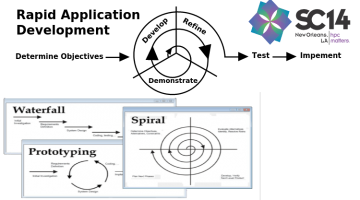
It feels like an oxymoron to speak of interpreted languages for HPC much like ordering "jumbo shrimp". The ease of programming coupled with an ability to augment RAD (Rapid Application Development) languages like Python, R, and Julia with high-performance back-end methods is now being recognized by the HPC and cloud computing communities. In short, the RAD language provide … [Read more...]
Dongarra Gives Deep-Learning a Python Interface With RaPyDLI

An NSF-funded project called "Rapid Python Deep Learning Infrastructure", or RaPyDLI received nearly $1 million in NSF grants. The project led by supercomputing luminaries Jack Dongarra (University of Tennessee) and Geoffrey Fox (Indiana University) along with Andrew Ng (Stanford, Baidu and Coursera) will allow users to program deep learning models in Python and port them to … [Read more...]
Funding for HPC in the Natural Sciences at Mainz University

Many branches of the natural sciences are currently in the process of transition to the use of data-driven concepts. In recognition of this, the Carl Zeiss Foundation will provide EUR 750,000 over four years to fund the Competence Center for HPC in the Natural Sciences at the Institute of Computer Science of Johannes Gutenberg University Mainz (JGU). Jointly headed by Professor … [Read more...]