
TACC is hosting a meeting of the Intel Xeon Phi user group (IXPug) in Austin, TX July 8-9, 2014. IXPug has been created to promote the exchange of user experiences in adopting and using the Phi processors. Registration is free and open until July 1, 2014. Attend IXPug to start or enhance your Xeon (X86) programming skills on the Intel Many Integrated Core (MIC) architecture, … [Read more...]
WebCL for Safari

Cross-platform interest in WebCL is expanding with support for Firefox, Chrome as well as Safari. WebCL provides a tremendous opportunity to exploit parallelism on client-side machines. Thanks for to Antonio Gomes (Twitter @tonikitoo) who brought the Safari webkit-webcl implementation to our attention! The SMAST Computational Laboratory (CMLab) at the School for Marine … [Read more...]
Use a Single OpenCL Source Code to Compare FPGA and NVIDIA K1 Power and Performance
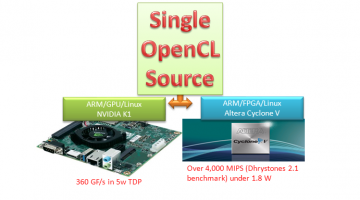
For many embedded applications power consumption is king. System On a Chip (SOC) designs such as the ARM-based Altera Cyclone V development board provides a Linux-based environment to program and run parallel applications on an FPGA using OpenCL much like the well-known NVIDIA Jetson development board. What a wonderful opportunity to compare the performance and power … [Read more...]
Microway Announces OpenACC GPU DevKit
Microway announced their new WhisperStation GPU Starter DevKit with OpenACC. The starter kit enables programmers to quickly bring the power of GPU computing with OpenACC. The bundle includes an NVIDIA Tesla K20-equipped WhisperStation and a license for PGI Accelerator C/C++/Fortran Compilers with OpenACC. … [Read more...]
IWOCL 2014 (International Workshop on OpenCL) presentations are now online
IWOCL 2014 presentations are now available online. The International Workshop on OpenCL (IWOCL) is an annual meeting of OpenCL users, researchers, developers and suppliers to share OpenCL best practise, and to promote the evolution and advancement of the OpenCL standard. The meeting is open to anyone who is interested in contributing to, and participating in the OpenCL … [Read more...]
Try Quantum Computing in Your WebGL-enabled Browser

GPUs are wonderful for running energy minimization algorithms where a system relaxes to a low energy state to solve a problem. The 13 PF/s Titan Deep-learning teaching code is a compelling example of this ability. Similarly, Quantum Computing solves a problem (like RSA encryption) by having a quantum system relax to a low energy state. Google has created a WebGL Chrome … [Read more...]
EPFL breaks Internet Security Candidate Discrete Logarithms Encryption in Two Hours

It is challenging even for experts to grasp the computational power now available to students and researchers. EPFL researchers decrypted a candidate for the Internet's future security systems based on "discrete logarithms". Allegedly tamper-proof, it could only stand up to the school machines' decryption attempts for two hours. More information: Robert Granger, Thorsten … [Read more...]
Pragma Puzzler – Ambiguous Loop Trip Count in OpenMP and OpenACC

Pragma-based programming can be described as a "negotiation" with the compiler where the compiler has to assume corner-cases that are not apparent to the programmer. So why does the loop count in the OpenMP and OpenACC article, "A First Transparent OpenACC C++ Class" have to be assigned to a separate variable to generate a parallel … [Read more...]
A First Transparent OpenACC C++ Class
This article provides a simple yet complete working example that demonstrates how OpenACC 2.0 pragmas can be used in the constructor and destructor of a C++ class to allocate and free memory on both the host and device and to transparently move data in the C++ class to support C++ class methods that run on both the host and device. Key to the transparent use of C++ classes in … [Read more...]
NVIDIA’s Women Who CUDA Campaign – May 30, 2014 Deadline!

On May 8, 2014 NVIDIA launched the Women Who CUDA campaign to highlight the work of innovative women in the area of GPU computing. Winning entries in the CUDA Women survey (click here to enter) - that is open until May 30, 2014, will be published on the high-visibility, high-volume NVIDIA website. Tweets during the campaign will provide visibility in the GPU computing community … [Read more...]