
The 4th HPCAC-ISC Student Cluster Competition, to be featured at ISC 2015 in Frankfurt Germany. The competition is fierce but rewarding! Work to unseat the reigning team from South Africa that has won the competition two years in a row. This is also an excellent opportunity for students to showcase their talents to the more than 2,600 attendees and 160 exhibitors from around … [Read more...]
Houston Workshop: Directives and Tools for Accelerators: A Seismic Programming Shift

With space for 70-80 participants, those who wish to attend the FREE University of Houston workshop, "Directives and Tools for Accelerators: A Seismic Programming Shift" must register by October 10th, 2014. The workshop is a fill-day event on October 20th, 2014, with a preceding welcome reception on October 19th, 2014. THis workshop is organized by the HPC Tools group in the … [Read more...]
GPUs Power Over 90% of ImageNet Deep-Learning Visual Recognition Challenge Entries
Over 90 percent of the participating teams and three of the four winners in the prestigious 2014 ImageNet Large Scale Visual Recognition Challenge used GPUs to enable their deep learning work. Deep learning is a fast-growing segment of machine learning that involves the creation of sophisticated, multi-level or “deep” neural networks. These networks enable powerful … [Read more...]
RAD (Rapid App Development) Languages for HPC and Cloud – Python, R, Julia
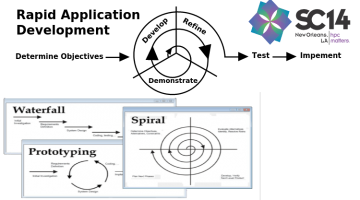
It feels like an oxymoron to speak of interpreted languages for HPC much like ordering "jumbo shrimp". The ease of programming coupled with an ability to augment RAD (Rapid Application Development) languages like Python, R, and Julia with high-performance back-end methods is now being recognized by the HPC and cloud computing communities. In short, the RAD language provide … [Read more...]
Dongarra Gives Deep-Learning a Python Interface With RaPyDLI

An NSF-funded project called "Rapid Python Deep Learning Infrastructure", or RaPyDLI received nearly $1 million in NSF grants. The project led by supercomputing luminaries Jack Dongarra (University of Tennessee) and Geoffrey Fox (Indiana University) along with Andrew Ng (Stanford, Baidu and Coursera) will allow users to program deep learning models in Python and port them to … [Read more...]
Funding for HPC in the Natural Sciences at Mainz University

Many branches of the natural sciences are currently in the process of transition to the use of data-driven concepts. In recognition of this, the Carl Zeiss Foundation will provide EUR 750,000 over four years to fund the Competence Center for HPC in the Natural Sciences at the Institute of Computer Science of Johannes Gutenberg University Mainz (JGU). Jointly headed by Professor … [Read more...]
Lustre Delivers 10x the Bandwidth of NFS on Intel Xeon Phi
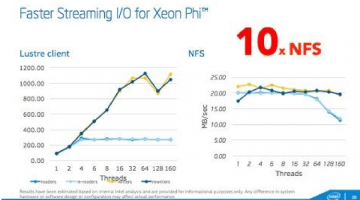
Lustre on Intel Xeon Phi delivered 10x the bandwidth of NFS as reported in the 2014 Lustre User Group (LUG) presentation "Running Native Lustre* Client inside Intel® Xeon Phi™ coprocessor" by Dmitry Eremin, Zhiqi Tao and Gabriele Paciucci of Intel Corporation. Network file systems are essential to the current generation of Knights Corner Intel Xeon Phi coprocessors because the … [Read more...]
OpenACC Compilers Deliver 85% The Performance Of Hand-Optimized Code

Directive-based compilers offer both portability and the ability to optimized code for specific platforms such as GPUs and CPUs. A recent LCPC14 paper, "Directive-Based Compilers for GPUs", by Swapnil Ghike, Ruben Gran, Maria J. Garzaran, David Padua at the University of Illinois at Urbana-Champaign found OpenACC code generated by the PGI and Cray OpenACC compilers achieved … [Read more...]
PGI OpenACC 14.7 Available

Release 14.7 of the PGI compiler is now available for download. PGI Accelerator Features and Enhancements Support for CUDA managed data in CUDA Fortran Expanded OpenACC C++ Support Expanded OpenACC Features C global (extern) variables in OpenACC declare directives Fortran module variables in OpenACC declare directives Full support for the atomic … [Read more...]
Beowulf 20 Year Workshop To Also Honour Thomas Sterling
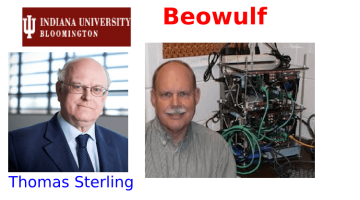
The Center for Research in Extreme Scale Technologies (CREST) at the University of Indiana will organize a workshop to celebrate 20 years of Beowulf and to honour Professor Thomas Sterling for his 65th birthday. The workshop will be held October 13-14, 2014. Visit the 20 Years of Beowulf website to register or learn more. The Beowulf project introduced clusters build from … [Read more...]