
Netflix is now streaming the hugely popular Breaking Bad series in 4K Ultra HD resolution. The adoption of 4K content coupled with heavy demand for retina quality displays and long battery life in laptops, tablets and cellphones means that GPU technology companies such as AMD, NVIDIA, Qualcomm, and Intel have a strong incentive … [Read more...]
NVIDIA App Showcase, See What Performance is Possible

Considering utilizing GPUs in your application? The NVIDIA Application Showcase is a great place to examine a broad spectrum of applications that have been GPU accelerated and the speedups that have been achieved. The recently updated list now contains descriptions, links, and performance reports for over 270 GPU accelerated applications. … [Read more...]
NVIDIA Tegra K1 Powered Shield Should Soon Be Available
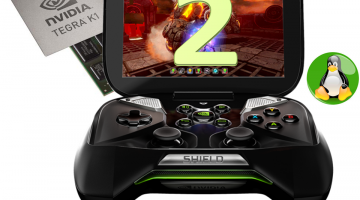
A revised "P2750" NVIDIA Shield gaming device has now appeared in an FCC filing. This suggests that suggests we will soon start seeing a number of NVIDIA Tegra K1 powered devices on store shelves.TechEnablement.com reported some early specifications and benchmark results for a K1-powered Shield that should perform well and can run android or be rooted to … [Read more...]
WebCL for Safari

Cross-platform interest in WebCL is expanding with support for Firefox, Chrome as well as Safari. WebCL provides a tremendous opportunity to exploit parallelism on client-side machines. Thanks for to Antonio Gomes (Twitter @tonikitoo) who brought the Safari webkit-webcl implementation to our attention! The SMAST Computational Laboratory (CMLab) at the School for Marine … [Read more...]
Try Quantum Computing in Your WebGL-enabled Browser
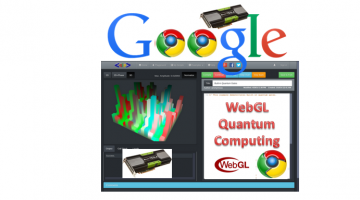
GPUs are wonderful for running energy minimization algorithms where a system relaxes to a low energy state to solve a problem. The 13 PF/s Titan Deep-learning teaching code is a compelling example of this ability. Similarly, Quantum Computing solves a problem (like RSA encryption) by having a quantum system relax to a low energy state. Google has created a WebGL Chrome … [Read more...]
Pragma Puzzler – Ambiguous Loop Trip Count in OpenMP and OpenACC

Pragma-based programming can be described as a "negotiation" with the compiler where the compiler has to assume corner-cases that are not apparent to the programmer. So why does the loop count in the OpenMP and OpenACC article, "A First Transparent OpenACC C++ Class" have to be assigned to a separate variable to generate a parallel … [Read more...]
MultiOS Gaming CUDA & OpenCL Via a Virtual Machine

Update 12/1/14: Intel now offers through the Xen project full GPU virtualization for Intel 4th generation devices. Operating system virtualization is a convenient way to run multiple operating systems at the same time, on the same hardware, without requiring rebooting. There are several technologies that allow sharing of the GPU by both the host (native) and guest … [Read more...]
May 2014 Current K1 Development Pathways

NVIDIA Tegra K1 Jetson development kits are now available for purchase from Newegg or Microcenter. The NVIDIA Tegra K1 chip has generated much interest due to the CUDA programmability and power efficiency of the ARM/Kepler ceepee-geepee combination. Upcoming Tegra K1 devices include the Xiaomi MiPad, NVIDIA's reference design tablet, plus the K1 powered Shield 2 gaming device. … [Read more...]
The Missing Link in NVlink, or “Hello Pascal” bye-bye PCI bus limitations!
Say hello to NVlink, a new technology by NVIDIA that is not constrained by PCIe bandwidth and latency limitations, but you will have to wait for the Pascal generation of 2016 GPUs to get it. NVlink is NVIDIA's properitary "DRAM speed and latency" class interface for CPU to GPU and GPU to GPU point-to-point communications. The basic building block for NVLink is a high-speed, … [Read more...]
PGI 14.4 is now released with lots of OpenACC C++ Goodness!

PGI 14.4 is now released with lots of OpenACC C++ goodness. Give it a try! Here is the link for or those with existing licenses. If need be, get a 15 day trial license and use some of my OpenACC tutorials. PGI Trial keys Trial license keys are used for evaluating PGI software. They are valid for fifteen days. If you haven't already done so, you … [Read more...]