
PyFR is an open-source 5,000 line Python based framework for solving fluid-flow problems that can exploit many-core computing hardware such as GPUs! Computational simulation of fluid flow, often referred to as Computational Fluid Dynamics (CFD), plays an critical role in the aerodynamic design of numerous complex systems, including aircraft, F1 racing cars, and wind turbines. … [Read more...]
Metagenomic Sequence Clustering using CUDA-enabled GPUs

There have been huge advances in DNA sequencing technologies in recent years; e.g. Illumina has just announced the HiSeq X system which can sequence human genomes at a cost of only $1000 per genome. Besides population-scale human genome sequencing another important application of sequencing technologies is environmental sequencing (so called metagenomics). Metagenomic studies … [Read more...]
Nvidia Talks About ARM64 and 64-bit K1 SoC

The Hot Chips 2014 conference conveyed some hot information this week about Nvidia's 64-bit Tegra K1 -the first 64-bit ARM processor for Android devices that pairs the dual-core "Project Denver" CPU with Nvidia's 192-core Kepler GPU (a ceepee geepee). The ARM-based Denver CPU was custom designed by Nvidia and is compatible with ARM's 64-bit ARMv8-A architecture. The chip is … [Read more...]
DARPA Goals, Requirements, and History of the SyNAPSE Project

The DARPA Synapse project webpage provides detailed information about the SyNAPSE project - including goals, requirements and history. The IBM TrueNorth SyNAPSE chip that has gained so much attention is one outcome of this project. Link: http://www.artificialbrains.com/darpa-synapse-program. Those at Supercomputing 2009 saw an early report on the project via the Supercomputing … [Read more...]
Amazing Animated Images with Autodesk Draco and Kitty – Yes Even For WordPress!

Way cool for illustrations! Add animated images as an image to your website or WordPress blog. The following "images" were just copied and pasted into this WordPress post. No other work required! Draco was pioneered by Rubaiat Habib, Fanny Chevalier, Tovi Grossman, Shengdong Zhao and George Fitzmaurice as means to revolutionize the way illustrators and animators … [Read more...]
SC14 – Fast Hybrid GPU Betweenness Centrality Code Achieves Nearly Ideal Scaling to 192 GPUs
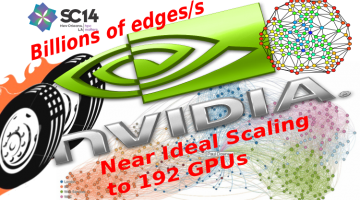
Don't miss the SC14 presentation Wednesday Nov. 19 in room 388-89-90, for the presentation of the McLaughlin and Bader paper "Scalable and High Performance Betweenness Centrality on the GPU". The authors report nearly ideal scaling to 192 GPUs and billions of edges traversed per step (GTEP). The paper can be downloaded here and their software can be downloaded from … [Read more...]
Robots that See Through Solid Walls Using Wi-Fi
For the past few years Yasamin Mostofi, professor of electrical and computer engineering at UCSB and her team have been busy realizing the dream of X-ray vision.by enabling robots to see objects and humans behind thick walls through the use of radio frequency signals. The project page is here. Dr Mostofi received the Presidential Early Career Award in … [Read more...]
A Simple Way to Add Aspect-Preserving Responsive Design HTML5 Animations Using WebGL

Learn how to include really fast WebGL accelerated interactive 3D content in your posts - including responsive design WordPress sites like TechEnablement! This first in a series of Web-Dev tutorials teaches how to add an interactive 3D text animation to via a simple embedded iframe HTML statement. The CSS is included in the HTML so no site css modifications required! The … [Read more...]
42 PF/s Trinity Supercomputer to Use Intel Knights Landing

First details on the National Nuclear Security Administration (NNSA) Trinity Supercomputer show that the 42 PF/s system costing $174M USD will run a combination of Intel Haswell and Knights Landing processors. In particular the Intel Xeon Phi devices will use Micron’s Hybrid Memory Cube technology, which will greatly help memory bandwidth and memory capacity limited … [Read more...]
Part 2: No Idle Time CUDA Task Parallelism Across Eight GPUs

Part 1 in this tutorial series showed that task-based parallelism using concurrent kernels can accelerate applications simply by plugging more GPUs into a system - just as the GPU strong scaling execution model can accelerate applications simply by installing a newer GPU containing more SMX (Streaming Multiprocessors). No recompilation required! NVIDIA nvvp timelines show very … [Read more...]