Making informed decisions about data center operating costs requires the sharing of accurate, real-time data with those decision makers who are vested with maximizing profitability in both cloud and enterprise environments. The FieldView Data Center Infrastructure Management (DCIM) solution is designed to help customers make effective use of their assets, space and especially energy dollars. Utilized by six of the top 10 banks, three of the five top technology and cloud providers, and 15 of the largest Co-Lo facilities in the world, FieldView Solutions is a global DCIM solution. The company notes they are so scalable that they currently monitor 2.5 Gigawatts worth of power at organizations located on six continents.
Sev Onyshkevych, the CMO for FieldView Solutions says, “We provide the bridge between the facilities and IT worlds”. Their products, “allow both parties to move across the aisle to make decisions”.

Sev Onyshkevych (Image courtesy FieldView)
A real value-add lies in the ability to plan for both peak power utilization and IT expansion. For example, a very conservative customer can plan based on the maximum power draw allowed for a rack – a metric that tends to heavily overestimate power utilization leading to wasted resources. Such planning occurs when a popped power breaker that causes a brief shutdown can result in significant loss, say at a financial institution. Such losses tend to get people fired.
A common procurement pattern for a new data center is to design it to initially support the most conservative power plan. Once the data center is built and in operation, the FieldView software can then monitor energy consumption. As a rough rule of thumb, Sev noted that customers are able to safely add roughly 30% additional computing capability – thus maximizing the data center investment. Further, the FieldView heat mapping analysis can be used to identify and correct hotspots. In one example, a customer was able to raise the average temperature in their machine room by four degrees to realize a 15% reduction in energy consumption.
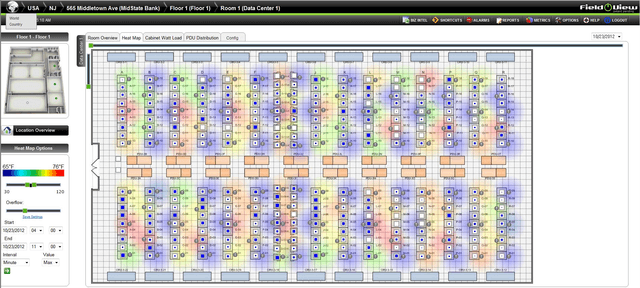
Example Heat Map (Image courtesy FieldView)
What makes the FieldView Infrastructure Management software special is its ability to both gather, store, analyze – and very importantly – share data with other applications. The ability to create custom integrations for individual applications via data links that streamline and share power, cooling, historical and other critical information ranks high in the justification to select FieldView.
For sharing data with other applications, the two core APIs are:
- DataView™ – A non-compressed cache of data for a wide variety of applications to access or publish historical and trending data for asset management and capacity planning needs.
- LiveView™ – A live temperature and power feed that offers the most recent measurement readings for an at-a-glance view of global data center operations.
Together, these two features enable FieldView DCIM to connect with virtually with any application whether it is volumes of historical data for trending or real-time data for quick monitoring and measurement.
To assist in the interpretation of this data, the FieldView DCIM offers these unique features:
- Extended Business Intelligence (BI) capabilities – BI functionality have been greatly enhanced, including capacity planning of space, power and cooling.
- Data Warehouse Excel Integration – Fully-customizable Excel features enable users to save any query or run any regression.
- Enhanced control of polling and alarming – More flexible abilities to tweak polling frequencies for different devices and systems, along with additional granularity and options on alarming.
- Enhanced Dashboards – With the use of configurable widgets, FieldView’s user dashboards can now be customized. Whether the end user wants to view PUE data or just alarms, this new feature provides only the information desired.
- “What If” Planning Scenarios – Predictive analysis is critical to data center operations and FieldView DCIM has functionality to help forecast space, power and cooling requirements vs. available capacity, and to simulate the impact of potential deployments of planned maintenance downtime, and of various failure scenarios.
- Ticketing System Integration – Full integration with industry-leading ticketing systems enables integration with customers’ operational processes for resolving critical alerts. FieldView DCIM generates alarms, and aggregates alarms generated by the systems it monitors.
- Mobile – Leveraging HTML5, FieldView DCIM information is optimized for smart phones and tablet viewing and interaction.
- Internationalization – FieldView will offer five languages: Chinese, Portuguese, Japanese, German, and Spanish as well as inherent capability of operating and capturing data in Metric or Imperial units.
- Energy Optimization – Enhanced reports provide power, cooling and space trending information to identify servers with long-term power draws and other anomalies.
- IT Asset Management Integration – Newly enhanced version now has a common format for importing and synchronizing data – making a simpler and deeper connection to asset management tools to automatically share information.
For customer case studies and a comprehensive FieldView DCIM ROI survey conducted by EMA analysts request a copy of the FieldView Solutions white paper, “Quantifying Data Center Efficiency: Achieving Value with Data Center Infrastructure Management“.
FieldView competitors are:
Leave a Reply