The 2015 CES keynote by Intel CEO Brian Krzanich has been receiving high praise. Spanning a wealth of product innovation, Krzanich discussed towards the end of his keynote the Intel® Curie™ module for wearable devices that has the potential to save lives and even reduce health and auto insurance rates. Specifically, the Intel Curie module is a complete low-power solution designed for “always-on” wearable technology solutions such as social media, sports, and fitness activities that can enable efficient and intelligent wearable solutions for a broad range of form factors—including rings, bags, bracelets, pendants, fitness trackers, even buttons.
Wearable technology is a burgeoning high-growth area in technology right now. Many people are familiar with the FitBit bracelets. Positoned as an enabling technology, Curie is a tiny module the size of a button that contains a Quark SOC, Bluetooth, sensors, and that has the ability to run for extended periods of time on a coin-sized battery. “Curie … changes the games of wearables”, said Krzanich.
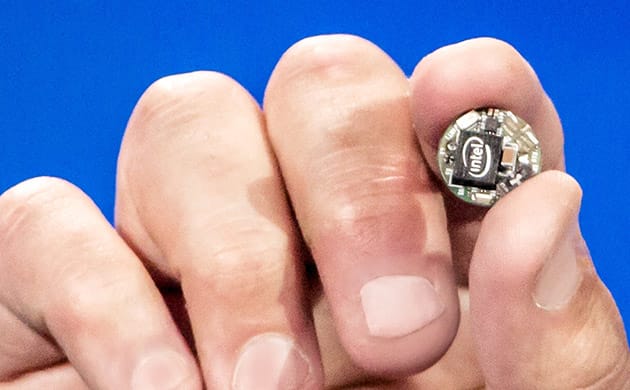
(image courtesy engadget)
One life saving example of wearables where Curie can have an impact has been shown by BlackBox Biometrics. Their Linx Impact Assessment System (IAS), scheduled for release in 2015, will provide real-time impact data on a smartphone or tablet for any athlete in any sport. Concussions are a major issue with athletes, with an estimated 3.8 million yearly sports-related concussions in the USA. On a personal note, a friend in high school, Casey Hennessy died from repeated concussions received while playing football. Linx is derived from BlackBox Biometrics products developed for the military to detect blast injuries.
It is likely that health insurers will provide reduced rates for customers who provide regular feedback from wearables. Insurers already use data points like BMI (body mass index) to set rates.Vaughn Kauffman, a health industries advisor at Pricewaterhousecooper said, “If you think of the wearable devices as a way to value improvement of BMI, who knows maybe one day — it’s scary to think — but maybe on a real time basis, the healthier you get the lower your premiums go.” (source Forbes).
Tracking “gadgets” already play a role in car insurance. Google and Apple are poised to disrupt the auto industry as a result of their GPS map applications. Usage-based insurance programs, also called telematics, are a small but growing segment of the auto insurance business. In short, real-time data from smartphones give insurance companies the ability to monitor driving habits such as distance driven, speeding, and aggressive behavior on an individual basis. Thus low-risk and short-distance drivers can be charged a lower rate without increasing the probability of having to payout for an accident.

(courtesy Wikipedia Commons)
Consumers appear to be willing to accept smart phone telematics, making both Apple and Google even more valuable.
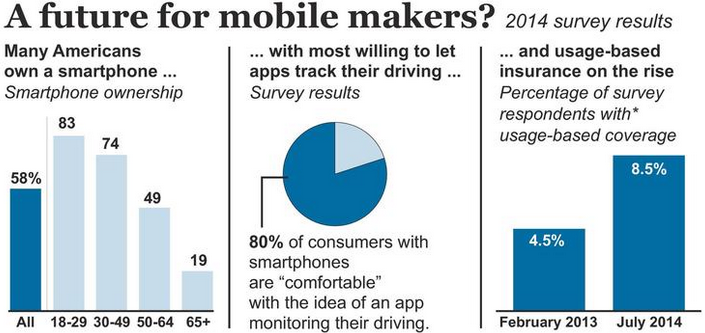
(Image courtesy The Chicago Tribune)
The Intel Curie Module includes:
- Low-power, 32-bit Intel® Quark™ microcontroller
- 384kB flash memory, 80kB SRAM
- Low-power, integrated DSP sensor hub with proprietary pattern matching accelerator
- Bluetooth Low Energy
- 6-axis combo sensor with accelerometer and gyroscope
- Battery charging circuitry (PMIC)
For more information, see the Intel Curie Fact Sheet.
Leave a Reply