Where: Texas Advanced Computing Center, J.J. Pickle Research Campus, ROC Building 196, 10100 Burnet Road Austin, TX 78758 When: Tuesday, April 22, 2014, 8:30 AM - 4:00 PM This one-day training will provide software developers the foundation needed for modernizing their code to take advantage of parallel architectures found in both the Intel® Xeon® processor and the Intel® … [Read more...]
TechEnablement Adds Study Guides for CUDA, OpenACC, OpenCL, and Intel Xeon Phi
Today techEnablement.com has provided study guides to help students "learn to change the world" with supercomputing for the masses . The study guides cover: CUDA OpenACC OpenCL Intel Xeon Phi … [Read more...]
Intel Xeon Phi for CUDA Programmers

Both GPU and Xeon Phi coprocessors provide high degrees of parallelism that can deliver excellent application performance. For the most part, CUDA programmers with existing application code have already written their software so it can run well on Phi coprocessors. The key to performance lies in understanding the differences between these two architectures. Author's note: To … [Read more...]
Intel Releases OpenCL™ 1.2 Support for Xeon Phi™ Coprocessors

The Intel press room announced that OpenCL support is now available (link). The new SDK broadens options for developers on Intel® architecture and includes tools, optimization guides and training. The SDK helps OpenCL developers improve performance and efficiency on Intel® Xeon Phi™ coprocessors and Intel® Xeon® processors For those interested in using OpenCL to program … [Read more...]
Pick the Right WordPress Hosting

Updated July 2, 2016 (thanks to Paul Warren of Insiteful) WordPress is a free and open-source blogging tool and Content Management System (CMS). It was released on May 2003. According to Wikipedia, WordPress now powers more than 26.4% of the top 10 million websites as of April 2016. This represents significant growth as Wikipedia previously noted WordPress was used by 18.9% of … [Read more...]
HPC Balance and Common Sense
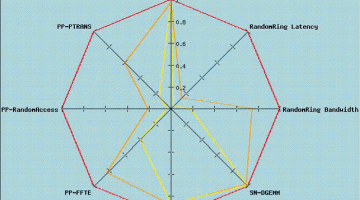
Key concepts for any procurement, system design, or system analysis are presented in my 2007 Scientific Computing article ( link ). A common sense approach is to keep what works and improve on what doesn’t. In other words, measure the performance characteristics of your current system(s) and keep those characteristics that support your workloads and improve on any that might … [Read more...]
Programming Intel’s Xeon Phi: A Jumpstart Introduction

Reaching one teraflop on Intel's new 60-core coprocessor requires a little know-how First printed December 10, 2012 on Dr. Dobbs ( link ) Developers can reach a teraflop/s of number crunching power via one of several routes: Using pragmas to augment existing codes so they offload work from the host processor to the Intel Xeon Phi coprocessors(s) Recompiling source … [Read more...]
Part 1: OpenCL™ – Portable Parallelism

This first article in a series on portable multithreaded programming using OpenCL™ briefly discusses the thought behind the standard and demonstrates how to download and use the ATI Stream software development kit (SDK) to build and run an OpenCL program. view at The Code Project (http://www.codeproject.com/Articles/110685/Part-OpenCL-Portable-Parallelism) The thought … [Read more...]
Pragmatic Parallelism Part 1: Introducing OpenACC 1.0
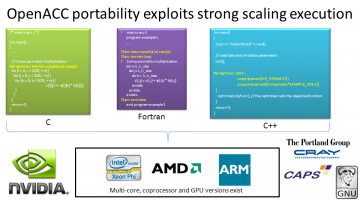
OpenACC lets you program in parallel C/C++ and Fortran in a manner that is concise and where the same source code can be recompiled to run on AMD GPUs, NVIDIA GPUs, Intel Xeon Phi, x86, and ARM. View at Dr. Dobbs (http://www.drdobbs.com/parallel/easy-gpu-parallelism-with-openacc/240001776) This is the first in a series of articles by Rob Farber on OpenACC directives, … [Read more...]
CUDA 6.0 Released

The CUDA 6 Production Release is now available for download at www.nvidia.com/getcuda. This version of the toolkit includes features that further simplify parallel programming like: • Unified Memory: simplifies programming by enabling applications to access the CPU and GPU memory without the need to manually copy data. • Drop-in Libraries: automatically accelerate … [Read more...]