• Home
  • News
  • Tutorials
  • Analysis
  • About
  • Contact

TechEnablement

Education, Planning, Analysis, Code

  • CUDA
    • News
    • Tutorials
    • CUDA Study Guide
  • OpenACC
    • News
    • Tutorials
    • OpenACC Study Guide
  • Xeon Phi
    • News
    • Tutorials
    • Intel Xeon Phi Study Guide
  • OpenCL
    • News
    • Tutorials
    • OpenCL Study Guide
  • Web/Cloud
    • News
    • Tutorials
You are here: Home / Featured article / Successful Farber SC14 Tutorial “From ‘Hello World’ to ExaScale Computing Using x86, GPUs and Intel Xeon Phi Coprocessors”

Successful Farber SC14 Tutorial “From ‘Hello World’ to ExaScale Computing Using x86, GPUs and Intel Xeon Phi Coprocessors”

December 11, 2014 by Rob Farber Leave a Comment

The Rob Farber SC14 tutorial “From ‘Hello World’ to Exascale Using x86, GPUs and Intel Xeon Phi Coprocessors” (tut106s1) went smoothly and was highly successful. The requests we received from our students at the tutorial to teach this, or a similar class in the US and around the world from the UK to India are a clear measure of our success. In particular, ours is the only class to teach and compare both GPUs and Intel Xeon Phi coprocessors. In addition, my MSI WS60 mobile workstation performed flawlessly.
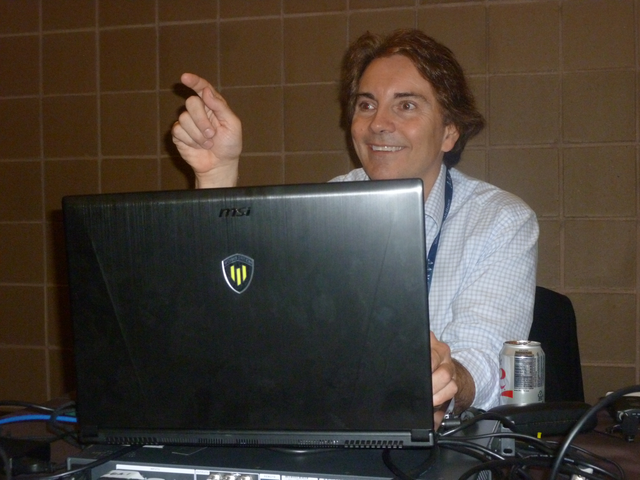
Rob Farber teaching at his SC14 tutorail

Rob Farber teaching his SC14 tutorial using an MSI WS60 Mobile Workstation that can run GPU codes on the internal Quadro K2100M

Use the “click me” button to request information for your own on-site or web-based training!

We had nearly 3x the expected number of attendees, which raised concerns if the Internet and local computing resources were able to support the needs of over 80 interactive users all concurrently compiling and running hands-on tutorial codes. Happily the teams at TACC and CreativeC made everything run smoothly. In particular, the three node CreativeC machine (containing 3 NVIDIA K40c GPUs and an Intel Xeon Phi Coprocessor per compute node) supported a load of over 60 concurrent users throughout the  all-day tutorial where each student was actively compiling and running interactive tasks.  (Click here to read about this system running mobile in a van on the way to SC14.) Not bad for a system that starts at $12k!
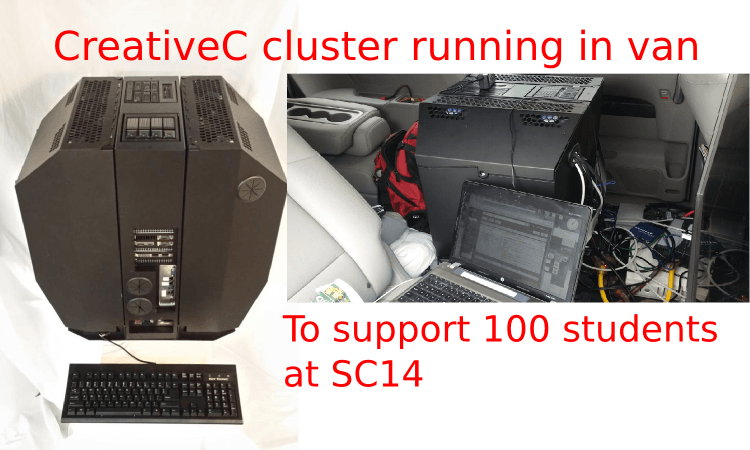
CreativeC Stella compute cluster running in a van while being transported to SC14

CreativeC Stella compute cluster running in a van while being transported to SC14

James Reinders (Director, Chief Evangelist, Intel Software, Intel Corporation, Portland, OR, USA) stopped by to speak briefly to the class and give away a few free copies of High Performance Parallelism Pearls.
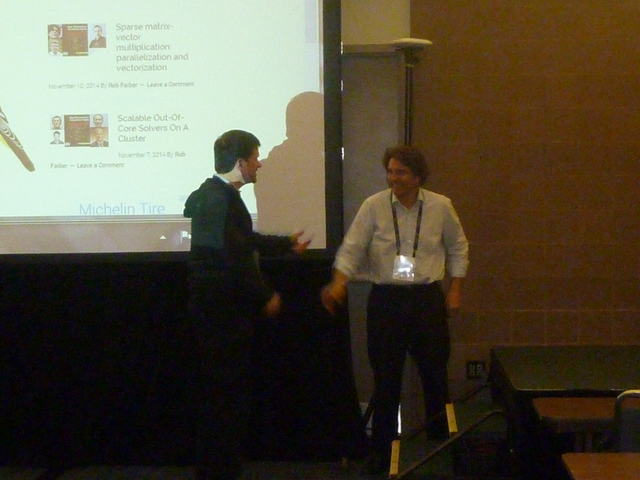
P1050747

James Reinders (Director, Chief Evangelist, Intel Software, Intel Corporation, Portland, OR, USA) with Rob Farber
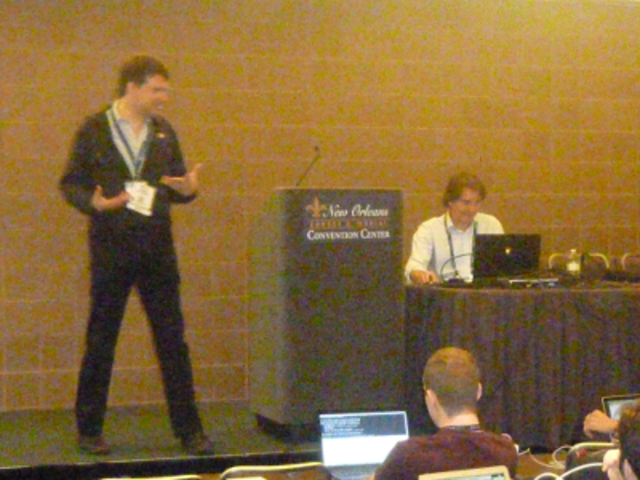
James Reinders and Rob Farber at SC14

James Reinders and Rob Farber at SC14

Special thanks to Greg Stantlen, Andree Jacobson, and Tim Thomas from CreativeC plus Jason Allison and Paul Navratil at TACC. This work used the Extreme Science and Engineering Discovery Environment (XSEDE), which is supported by National Science Foundation grant number ACI-1053575.
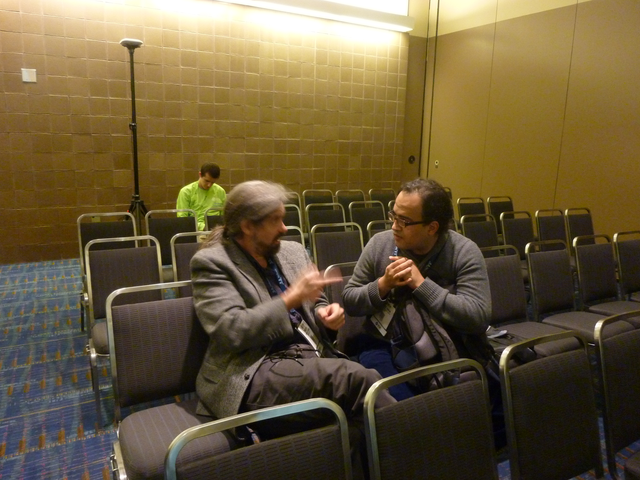
Tim Thomas working with a student

Tim Thomas working with a student

We are proud that nearly every student stayed for the entire all day tutorial
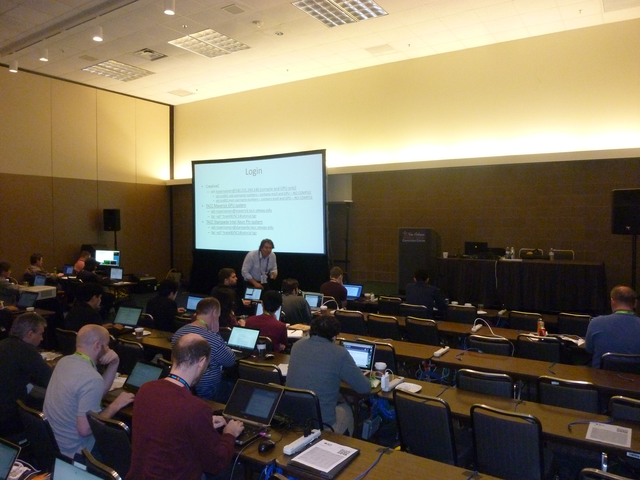
Students working at the SC14 tutorial by Rob Farber

Students working at the SC14 tutorial by Rob Farber

It was very busy yet quiet as a library!
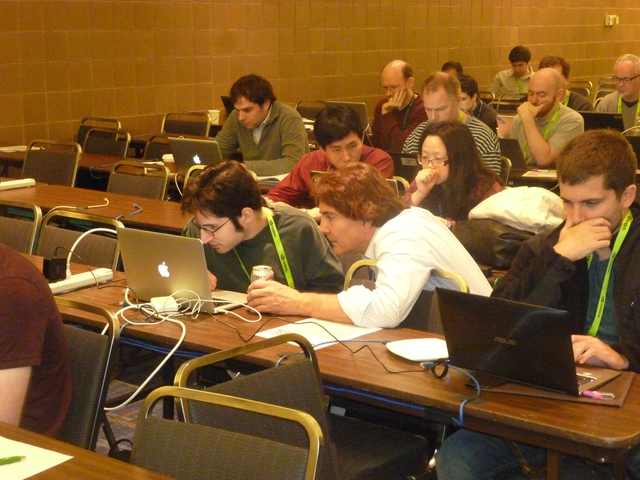
Rob Farber working with a student on a tutorial example

Rob Farber working with a student on a tutorial example

Share this:

  • Twitter

Filed Under: Featured article, Featured news, News Tagged With: HPC

Leave a Reply Cancel reply

Your email address will not be published. Required fields are marked *

Tell us you were here

Recent Posts

Farewell to a Familiar HPC Friend

May 27, 2020 By Rob Farber Leave a Comment

TechEnablement Blog Sunset or Sunrise?

February 12, 2020 By admin Leave a Comment

The cornerstone is laid – NVIDIA acquires ARM

September 13, 2020 By Rob Farber Leave a Comment

Third-Party Use Cases Illustrate the Success of CPU-based Visualization

April 14, 2018 By admin Leave a Comment

More Tutorials

Learn how to program IBM’s ‘Deep-Learning’ SyNAPSE chip

February 5, 2016 By Rob Farber Leave a Comment

Free Intermediate-Level Deep-Learning Course by Google

January 27, 2016 By Rob Farber Leave a Comment

Intel tutorial shows how to view OpenCL assembly code

January 25, 2016 By Rob Farber Leave a Comment

More Posts from this Category

Top Posts & Pages

  • Acer K1-powered Chromebook $279 for Pre-Order - Dual-boot Linux?
  • Tenure Track Position in Computer Science at Cal Poly San Luis Obispo
  • Unrestricted Pixar Renderman Free for Non-commercial Use - $495 Otherwise
  • Learn to Make Windows 10 Apps with Free Microsoft Course Then Add GPU Acceleration!
  • Monetizing Image Recognition By Looking at the Background

Archives

© 2026 · techenablement.com