The massively parallel mapping and code described in this chapter is generic and can be applied to a broad spectrum of numerical optimization and machine-learning algorithms ranging from neural networks to support vector machines to expectation maximization and independent components analysis. Many of these techniques are heavily used in lucrative data-mining and social media … [Read more...]
Intel Xeon Phi Provides Cambridge 30x Speedup in Production COSMOS WALLS Code

Professor Paul Shellard, the COSMOS Director at Cambridge University reports a 30x speedup of the heavily utilized production WALLS code and he notes "Our expectation is that all our cosmological field theory codes, like WALLS, will have similarly large speed-ups when optimized and ported to Xeon Phi." Currently the project is transferring a larger portion of the CMB analysis … [Read more...]
Parallel Evaluation Of Fault Tree Expressions
Readers are guided through a progression from a scalar fault tree code to one mapped effectively to Intel Xeon Phi with the open-source ispc (Intel SPMD Program Compiler). Fault trees express failure relationships between systems using Boolean logic to evaluate the vulnerability of systems based on component reliability, system redundancy, physical protection, and other — … [Read more...]
Plesiochronous (Loosely Synchronous) Phasing Barriers To Avoid Thread Inefficiencies
Jim Dempsey bests expert Intel programmers by 40% - 50% simply by using a little bit of ingenuity, along with a slightly different programming technique. He notes that, "a substantial portion of previously lost thread barrier wait time" can be recovered simply by using loosely synchronous (plesiochronous) barriers instead of strictly synchronous barriers. Jim points out that, … [Read more...]
Optimizing for Reacting Navier‐Stokes Equations
Antonio Valles and Weiqun Zhang note the optimizations discussed in their High Performance Parallelism Pearls chapter that, "significantly improved concurrency on both Intel Xeon Phi coprocessors and Intel Xeon processors" by transforming a fine-grain thread parallel approach to a more coarse-grain, memory allocation considerate approach plus improving vectorization. They … [Read more...]
Better Concurrency and SIMD On The HIROMB‐BOOS‐Model (HBM) 3D Ocean Code
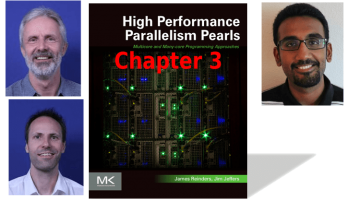
By utilizing the strengths of the Intel Xeon Phi coprocessor, the chapter 3 High Performance Parallelism Pearls authors were able to improve and modernize their code and "achieve great scaling, vectorization, bandwidth utilization and performance/watt". The authors (Jacob Weismann Poulsen, Karthik Raman and Per Berg) note, "The thinking process and techniques used in this … [Read more...]
From ‘Correct’ to ‘Correct & Efficient’: a Hydro2D case study with Godunov’s scheme

Poetically noting that "a rising tide lifts all boats", authors Guillaume Colin de Verdière and Jason D. Sewall demonstrate a 12x increase on Intel Xeon Phi and over 5x increase on Intel Xeon using, "a common set of optimizations [that] benefit both general-purpose Xeon processors and more specialized Xeon Phi accelerators" in chapter 2 of High Performance Parallelism … [Read more...]
The Unabridged Chapter 1 Introduction To High Performance Parallelism Pearls

Following is the full, unabridged text of the chapter 1 introduction (written by James Reinders) to High Performance Parallelism Pearls. Thanks to Morgan Kaufmann, James Reinders, and Jim Jeffers for giving permission so TechEnablment can make this available. After reading what James wrote, you will see that summarizing the introduction would simply have left out too much … [Read more...]
Teaching The World About Intel Xeon Phi
The newest book by James Reinders and Jim Jeffers, “High Performance Parallelism Pearls” distills the experience of sixty-nine HPC experts into twenty-eight chapters designed to teach the world about the performance capabilities of the massively-parallel Intel® Xeon Phi™ family of products. Source code for numerous working examples selected for their educational content, … [Read more...]
Latest Intel SDE Emulates New ISA Instructions For Knights Landing
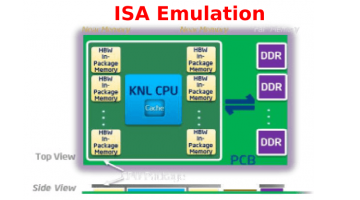
Intel has released a new version of the Intel SDE (Software Development Emulator) so that customers can start working with upcoming instruction set extensions like AVX-512 for Knights Landing. The SDE can be downloaded after accepting a user agreement and used on Windows, Linux, and OS. It can also be used with the GNU gcc. The current version is 7.2 released on July 29, … [Read more...]