
GNU has announced that GCC 5.0 will provide full support for Cilk Plus. Cilk Plus is an extension to the C and C++ languages to support data and task parallelism on multi-core, vector and Intel Xeon Phi coprocessors.It is reputed to be quite efficient and looks to be easy to use. The Intel icc compiler has supported Cilk Plus for years. GNU support now makes Cilk Plus available … [Read more...]
Dongarra Gives Deep-Learning a Python Interface With RaPyDLI

An NSF-funded project called "Rapid Python Deep Learning Infrastructure", or RaPyDLI received nearly $1 million in NSF grants. The project led by supercomputing luminaries Jack Dongarra (University of Tennessee) and Geoffrey Fox (Indiana University) along with Andrew Ng (Stanford, Baidu and Coursera) will allow users to program deep learning models in Python and port them to … [Read more...]
Lustre Delivers 10x the Bandwidth of NFS on Intel Xeon Phi
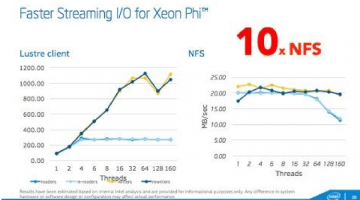
Lustre on Intel Xeon Phi delivered 10x the bandwidth of NFS as reported in the 2014 Lustre User Group (LUG) presentation "Running Native Lustre* Client inside Intel® Xeon Phi™ coprocessor" by Dmitry Eremin, Zhiqi Tao and Gabriele Paciucci of Intel Corporation. Network file systems are essential to the current generation of Knights Corner Intel Xeon Phi coprocessors because the … [Read more...]
Intel SPMD Compiler (ISPC) for Xeon and Xeon Phi

When #pragma SIMD is not enough, companies and projects such as Intel, Embree, Dreamworks, Pixar, Autodesk, and SURFsara are looking to the freely available Intel SPMD Program Compiler (ispc) to achieve high vector performance on Xeon and Intel Xeon Phi devices. ISPC is LLVM-based and designed to exploit Intel SIMD architectures … [Read more...]
NESAP – The NERSC Exascale Science Application Program – Eight Post-doc Positions to be Filled
DOE’s Office of Science is the single largest supporter of basic research in the physical sciences in the United States, and is working to address some of the most pressing challenges of our time. NERSC is currently hiring eight post-docs to assist this effort. The NESAP program at NERSC addresses the software issues that will arise as scientists adapt their applications to … [Read more...]
WRF Comparison – Neither Phi or NVIDIA M2070 Living Up to Name
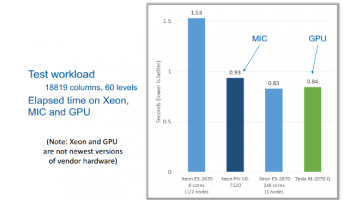
WRF (Weather Research and Forecasting) is an important benchmark for weather modeling, computational scientists, and procurements. WRF is a mesoscale numerical weather prediction system designed to serve both atmospheric research and operational forecasting needs. It allows researchers to generate atmospheric simulations based on real data (observations, analyses) or … [Read more...]
Paper Compares AMD, NVIDIA, Intel Xeon Phi CFD Turbulent Flow Mesh Performance Using OpenMP and OpenCL

Timely for Siggraph 2014 (because animations use meshes) and food-for-thought for CFD (Computational Fluid Dynamics) research, the paper by A. Gorobets, F.X. Trias, R. Borrell, G. Oyarzún and A. Oliva, "Direct Numerical Simulation of Turbulent Flows with Parallel Algorithms for Various Computing Architectures" considers structured and unstructured meshes for incompressible … [Read more...]
Hot At Siggraph 2014 – Multithreading for Visual Effects
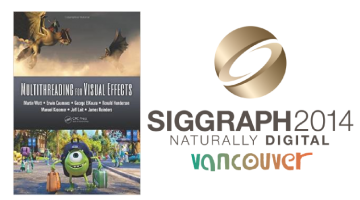
The ACM Siggraph conference starts tomorrow, August 10th, in Vancouver, BC. Multithreading for visual effects coupled with massive parallelism has changed the visual effects industry forever. A new book capturing that trend titled, appropriately enough, "Multithreading for Visual Effects", is an excellent source of information about how visual effects are currently performed at … [Read more...]
Open Call to Run on the Beacon Intel Xeon Phi System

The National Institute for Computational Sciences (NICS) at the University of Tennessee (UT) is pleased to announce the 2014 open call for participation in the Beacon Project, an ongoing research project funded by the National Science Foundation and UT to explore the impact of emerging computer architectures on computational science and engineering. Beacon is a Cray CS300-AC … [Read more...]
Argonne Extreme Training for Exascale Starts Aug 4th Covering OpenACC, OpenMP, MPI, and Vectorization

The Argonne Training Program on Extreme-Scale Computing starts next week. Paul Messina believes more institutions - including universities - need to offer such advanced training. The complexities of exascale computing are the reason as programming the current generation of leadership class machines requires knowledge of a broad spectrum of topics and many skills: both … [Read more...]