PathScale in collaboration with Cirrascale posted the fastest OpenACC SPEC-ACCEL results to date using an AMD Firepro s9150 GPU. ENZO 2015 is the first major PathScale release to include support for AMD Firepro devices and demonstrates the “pragmatic portability” of OpenACC to compile and run on a variety of hardware platforms using a single source base. The ENZO 2015 compiler suite was used to perform the test.
According to the summary base and peak SPEC ACCEL scores seen below, the PathScale ENZO compiler generating an AMD Firepro s9150 executable is now the fastest OpenACC solution compared to the previous SPEC ACCEL leader, the PGI 14.2 compiler suite generating code for an NVIDIA K40c.
SPEC ACCEL v1.0 SPECaccel_spec_peak results (Higher is better):
| Configuration | SPECaccel_spec_base | SPECaccel_spec_peak | %peak |
| PathScale on AMD s9150 | 3.10 | 3.21 | 96.5 |
| PGI on NVIDIA k40c | 2.98 | 3.14 | 94.5 |
Table 1: SPEC_accel summary results (Higher is better)
The SPEC ACCEL benchmark suite by Standard Performance Evaluation Corporation (SPEC) is based on respected benchmarks in the literature and designed to provide a vendor-independent performance proving ground. It provides 34 computationally intensive parallel applications that exercises the performance of an accelerator (e.g. GPU or Intel Xeon Phi), the host CPU, memory transfers, support libraries, drivers and compilers. Specifically, the nineteen OpenCL-based benchmarks are derived from the well-respected Parboil benchmark from the IMPACT Research Group of the University of Illinois at Urbana-Champaign and the Rodinia benchmark from the University of Virginia. The OpenACC suite includes fifteen tests from NAS Parallel Benchmarks (NPB), SPEC OMP®2012, and others derived from high-performance computing (HPC) applications.
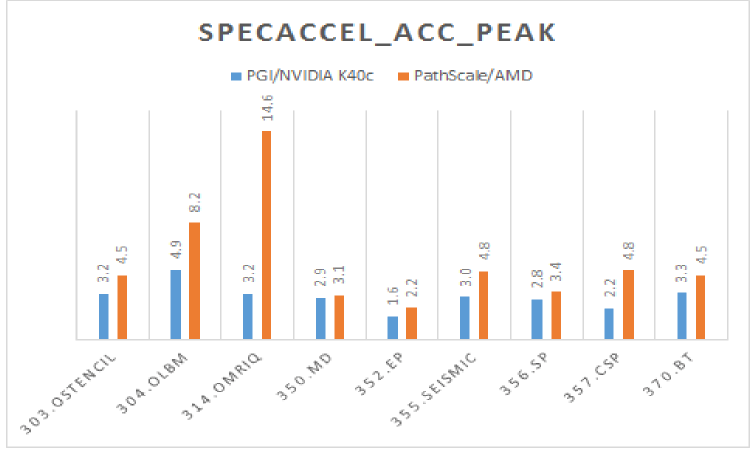
PathScale’s CTO Christopher Bergström noted that the consistency of the PathScale base to peak performance (Ed: 96.5% vs. NVIDIA’s 94.5% shown in Table 1) was highlighted during SPEC-ACCEL testing as the ENZO 2015 generated GPU executable pushed the test hardware to the point where the machine had to throttle back performance to prevent overheating. Both hardware and software performance was restored simply by installing a larger cooling fan.
Leave a Reply