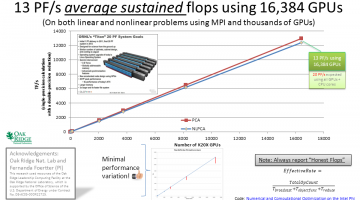
The deep-learning teaching code described in my book, "CUDA Application Design and Development" [Chapters 2, 3, and 9] plus online tutorials achieved 13 PF/s average sustained performance using 16,384 GPUs on the Oakridge Titan supercomputer. Full source code for my teaching code can be found on github in the farbopt directory. Nicole Hemsoth at HPCwire noted these CUDA … [Read more...]
TechEnablement Adds Study Guides for CUDA, OpenACC, OpenCL, and Intel Xeon Phi
Today techEnablement.com has provided study guides to help students "learn to change the world" with supercomputing for the masses . The study guides cover: CUDA OpenACC OpenCL Intel Xeon Phi … [Read more...]
Intel Xeon Phi for CUDA Programmers

Both GPU and Xeon Phi coprocessors provide high degrees of parallelism that can deliver excellent application performance. For the most part, CUDA programmers with existing application code have already written their software so it can run well on Phi coprocessors. The key to performance lies in understanding the differences between these two architectures. Author's note: To … [Read more...]
HPC Balance and Common Sense
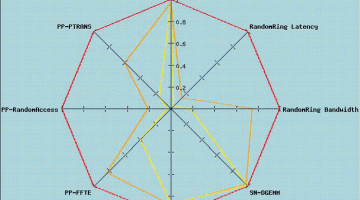
Key concepts for any procurement, system design, or system analysis are presented in my 2007 Scientific Computing article ( link ). A common sense approach is to keep what works and improve on what doesn’t. In other words, measure the performance characteristics of your current system(s) and keep those characteristics that support your workloads and improve on any that might … [Read more...]
Part 3 of CUDA Supercomputing for the masses
Error handling and global memory performance limitations. This article is reprinted from Dr. Dobbs (http://www.ddj.com/hpc-high-performance-computing/207603131). It is still valid as an introductory article. Congratulations! Thanks to Part 1 and Part 2 of this series on CUDA (short for "Compute Unified Device Architecture"), you are now a CUDA-enabled programmer with the … [Read more...]