
GPUs are wonderful for running energy minimization algorithms where a system relaxes to a low energy state to solve a problem. The 13 PF/s Titan Deep-learning teaching code is a compelling example of this ability. Similarly, Quantum Computing solves a problem (like RSA encryption) by having a quantum system relax to a low energy state. Google has created a WebGL Chrome … [Read more...]
GaussianFace: Computers Claimed to Beat Humans in Recognizing Faces
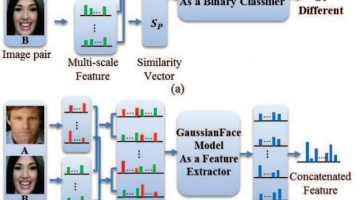
In a human vs. computer test on 13k photos of 6k public figures, the GaussianFace project claims to identify human faces better than humans (97% human accuracy vs. 98% computer accuracy). The authors claim their model can adapt automatically to complex data distributions, and therefore can well capture complex face variations inherent in multiple sources. The reporters at The … [Read more...]
PGI 14.4 Release Contains Much OpenACC C++ Goodness

PGI released their 14.4 and upcoming 14.7 OpenACC 2.0 roadmap. The expectation is that we will see the 14.4 release in early May and the 14.7 release in early July. Note: these are not official PGI dates. Analysis: The 14.4 support of atomic operations will enable many low-wait algorithms such as counters and massively parallel stacks. Improved reduction performance in … [Read more...]
(4/24 update) Signals from Nvidia’s Sumit Gupta

Sumit Gupta is a busy man. Named by HPCwire as a 2013 "Person to Watch", Sumit does not idly take time to create a blog post unless it conveys a message about the NVIDIA Tesla development and marketing effort. His recent blog, "Fostering an Explosion of Innovation in the Data Center", posted by Steve Hamm, recognizes how the data-center is going to be supporting mobile … [Read more...]
Deep-learning Teaching Code Achieves 13 PF/s on the ORNL Titan Supercomputer
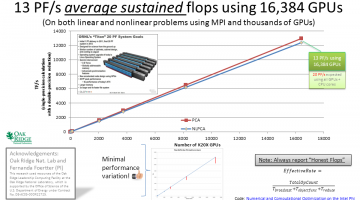
The deep-learning teaching code described in my book, "CUDA Application Design and Development" [Chapters 2, 3, and 9] plus online tutorials achieved 13 PF/s average sustained performance using 16,384 GPUs on the Oakridge Titan supercomputer. Full source code for my teaching code can be found on github in the farbopt directory. Nicole Hemsoth at HPCwire noted these CUDA … [Read more...]
Intel Xeon Phi for CUDA Programmers

Both GPU and Xeon Phi coprocessors provide high degrees of parallelism that can deliver excellent application performance. For the most part, CUDA programmers with existing application code have already written their software so it can run well on Phi coprocessors. The key to performance lies in understanding the differences between these two architectures. Author's note: To … [Read more...]
Farber teaches massively parallel computing to grade 6 – 12 students in Saudi Arabia
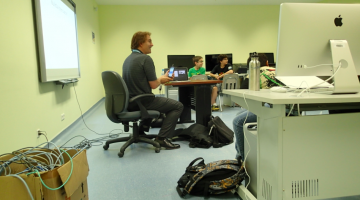
My book, “CUDA Application Design and Development” [English][Chinese] and Doctor Dobbs tutorials coupled with the rapid adoption of GPU computing have given me the opportunity to speak and teach around the world. This January, I had the pleasure of traveling to Jeddah, Saudi Arabia to speak and teach a short course on OpenACC and CUDA at KAUST (the King Abdullah University of … [Read more...]